Photos In “Frames”

Tyler is a photographer whose blog I follow. His shots almost always feature trees or at least some aspect of nature. Lots of leaves, stones, logs, and lichen. You should go there and take a look at The Ancient Eavesdropper.

His most recent photo challenge was to frame our shots in an interesting way. I’m by no means as good as Tyler, but I like to fool around with the Fuji and see what I can come up with. I’ve been meaning to take some pictures by the Kalamazoo River near downtown in my fair city. The river’s usually pretty quiet there, but the critters can be lively. Last night I stopped on my way home as the sun was setting. These are what I captured.

Canada geese flock all over here. Some even stay in winter if they can find food.

ducks framed 2

Looking northwest to the Hart-Dole-Inouye Federal Center, I took this long gander at a lone park bench (pun intended).

Fed Center framed

A lamp post ‘tunnel’ and a pattern in the railings frequently seen in Cereal City.

lampost tunnel

The path goes both ways and I thought of Robert Frost and that road less traveled.

lampost center framed

Next time I take the camera down to the river, I believe I’ll try early morning when the sun is on the other side of these same scenes. Perhaps I’ll even wait for December and venture out in the snow.

Be a blessing to somone today.

The Red Letter Life: A Book Review

Hello, Media Monday, when we talk about books, movies or music. Today’s offering: “The Red Letter Life: 17 Words From Jesus to Inspire Simple, Practical and Purposeful Living” by Bob Hostetler.

The adjectives in the subtitle of this book, The Red Letter Life give us a hint into Bob Hostetler’s message for living as a disciple of Jesus. Hostetler writes with purpose; his message is practical; and his writing is simple so anyone can understand it.the-red-letter-life-872316900

Hostetler has delivered his message in a ‘pure’ way: truth, grace, simplicity and clarity of thought are all in place. Sure, he uses his knowledge of Greek to explain things. But he only does it to enhance the message. I never got the feeling I was being talked down to because these explanations are not overdone.

The seventeen words chosen are excellent choices and indicate the author’s careful study of Jesus’ message and mission. From “Come” to “Go,” every word inspires us to deeper relationship with Christ and a call to carry out His mission as commanded. Often, we get to see Jesus, his disciples and the people He encountered with fresh eyes. Expect some “Aha” moments.

Hostetler has a way of telling stories which not only lend themselves to giving meaning to his message, they often are entertaining and sublime. That’s the way Jesus Himself told parables. Overall, his heart and personality shine through. He makes being a Christian sound challenging and enjoyable at the same time. After reading The Red Letter Life, I would enjoy sitting down with the author, simply talking about our respective spiritual journeys.

While not your typical Bible study text (with questions for participants to explore), the book could certainly be used as such because Bob offers a challenge at the end of each chapter. At any rate, the book begs to be discussed. Lately, I read less Christian non-fiction than I used to, choosing more often to study the Bible. While there is no substitute for God’s Word, there are certainly excellent supplements. This one happens to be one of them.

You can find Bob–a speaker, blogger and pastor, in addition to being an author–in “Stuff I Read.” He’s the One Prayer Daily fellow.

A Visit to Zootopia

Released in theaters March 2016, Zootopia is now on DVD. I have to say if you didn’t catch it at the theater, you must see it now.

Zootopia is smart, funny, and full of color. That’s typical of Disney movies. We can also expect endearing characters, a great plot, and a moral to the story.

Zootopia brings it home in all respects.

A cute little bunny, Judy Hopps, is determined “to make the world a better place” by becoming the first rabbit police officer. Her parents prefer she stay at home with her 275 brothers and sisters living a risk-free life. But carrot farming isn’t in the stars for Judy and she knows it.

She attends Zootopia Police Academy and, although she graduated at the top of her class, is assigned to ticketing cars at expired parking meters.

Zootopia police have been stymied by 14 cases of missing predators. When an otter goes missing, Judy convinces Chief Bogo she can solve it. Bogo gives her 48 hours.

Judy decides to enlist the help of Nick Wilde, a fox who lives up to the stereotype. He’s clever and sassy. Judy uses Nick’s shady practices to trick him into assisting her and the story begins to unfold as a true detective tale.

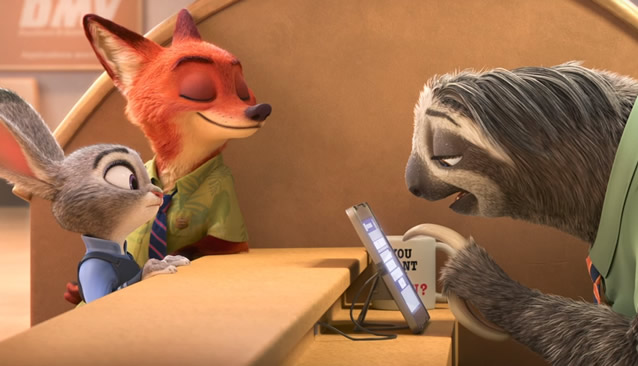
Rabbit and fox are fortunate enough to discover a license plate number in the sketchy file Judy’s been given. That plate number leads them to the DMV where Nick has a friend, Flash, who proves a big help. But Flash, like his co-workers, is a sloth.

Uh-oh.at the DMV

For anyone who’s waited at the DMV, you’ll relate. Nick and Judy get to the counter immediately. But…er…you’ll love the sloths. Watch Judy be her usual upbeat self. Watch Nick bait Flash into a conversation. Watch Flash finish a sentence. Watch Judy lose her cool. Watch Nick’s smug expression.

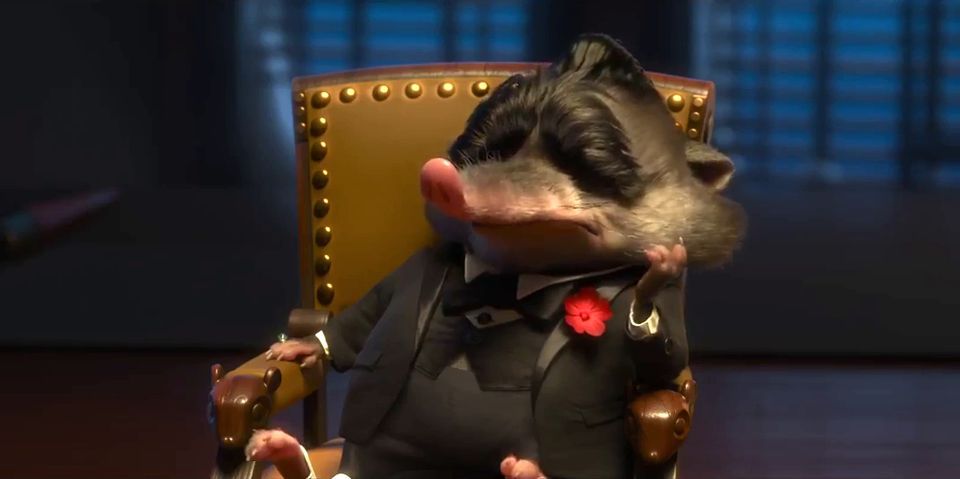
The plate number results in an address which leads the duo to the naturalists. The naturalists give them enough information to take them to Mr. Big. He has enough information to lead them to a place where they hear about night howlers. Wolves?

In their search for the missing otter, Judy and Nick play the roles of detective with everything they have in them. Judy proves she’s not a “dumb bunny.” Nick’s foxiness comes in handy, but he also begins to soften. They form a bond that could only happen in Zootopia, where predator and prey can live in harmony.

Zootopia includes the dense, color-rich scenes you expect of Disney Studios. The soundtrack is amazing. As usual, there’s visual humor and lines that kids probably won’t understand. (Think: Pixar’s Toy Story trilogy.) But that’s okay. Disney knows it’s the parents who bring the kids.

In the end, Zootopia shows us that we need friends who are loyal and always believe in us. We see that we can live in harmony with those who are different if all parties are willing to work together. Disney does it all so well. It’s a movie you’ll want to own so you can watch it whenever you need to see a great story told well. Or just for the laughs after a rough day.

One critic’s review named it “the best Disney movie in 20 years.” So hurry to the store and buy your copy.

Because you must see Zootopia now.

Mr Big

For parents: Zootopia is rated PG-13 for thematic material (animal violence), action scenes and some crude humor.

Reading the “Work” of Others

Last week, I finished a novel in which the main character’s job was so prominent that it seemed to be another character. The story convinced me that there is always more to what I read than I may expect. For instance, in the novel Rebecca, the house seems to become a character.

So for Labor Day, here’s a handful of books in which the occupation of the character(s) plays a large part in the plot. Several of these novels won awards and all have been best-sellers. Some have been re-created for television or on the big screen.stack of books

A Study in Scarlet by Sir Arthur Conan Doyle
The first of the stories in which consulting detective, Sherlock Holmes, and Dr. John Watson work together, sets the stage for many stories to come. Doyle created a character so intriguing, that his Sherlock Holmes stories have never gone out of print. In A Study in Scarlet, the mystery of the death is, naturally, quickly solved by Holmes with his new roommate amazed at his abilities. Watson gives us his observations on Holmes’ strengths and his weaknesses (yes, he has some). And if you’re anywhere close to enjoying a good mystery, Doyle’s Holmes stories just might become favorites.

Advise and Consent by Allen Drury
The world of politics, it seems, has always been a cutthroat business. In Advise and Consent, the story depicts how ruthless congressmen and senators can be. Lives are shattered, legislation is a tool for manipulation and even the president plays the games. The story has its good guys, but one message threads its way through the plot: Don’t trust anyone.

The Amazing Adventures of Kavalier and Clay by Michael Chabon
This is considered to be best-selling author, Chabon’s, magnum opus. It’s the story of how cousins Joe Kavalier and Sammy Clay make their way to the top in the world of comic books creators in a day when comic books were hot. Creating characters like Luna Moth and The Escapist come naturally considering the two young men’s backgrounds.

All Quiet on the Western Front by Erich Maria Remarch
The story of Paul Baumer, a young German soldier who enlisted with his friends to fight in The Great War, was so controversial to Adolf Hitler during the Third Reich that he banned the book. Baumer, who quickly becomes disillusioned after seeing the real horrors of war, declares a vow to live a different life when he makes it home. No more hate, regardless of a person’s background. Some have called this the greatest war novel of all time.

Empire Falls by Richard Russo
The owner of The Empire Grill, Miles Roby has put his life on hold for everyone. After 20 years of running a diner, he’s becoming frustrated with a life that feels controlled by everyone around him. He’s devoted to his daughter, Tick, he’s annoyed with his soon-to-be ex-wife and his past keeps coming back to haunt him. Russo created characters that truly come alive: we can relate to many of them. The dialogue often carries the story so that we might actually be feeling their emotions.

Lonesome Dove by Larry McMurtry
An epic western. A story of the west just before men began to creep into it and take over. Cowboys are moving a huge herd from Texas to Montana and then coming home. The perils include more than crossing rivers and fighting the weather, although both take their toll. This is a personal favorite of mine, which surprised me because I’d never read a western before. The tale is so well-told, I’d read it again.

The Martian by Andy Weir
Ever wonder what it’s like to be an astronaut and all the science stuff you’d need to know to be one? Here’s the book for you. Mark Watney is left behind on Mars after a dust storm forces his command crew to leave the surface, thinking him dead. Weir’s knowledge of computer systems, his hobby interest into all things to do with space flight and years of research create a story that’s believable and entertaining. In fact, Mark Watney becomes a guy we laugh with, cheer for, and for whom we hold on to the edge of our seats.

Remains of the Day by Kazuo Ishiguro
A story about an English butler may seem slightly less interesting than your usual fare. After all, the life of a butler can’t be very exciting, can it? Forget the drama of Downton Abbey, our hero takes a day trip and assesses his life after thirty years of service to the same household. This is a quiet assessment, as expected. But, as with many books about people and their private lives, his story may resonate with any reader.

This is only a partial list of books I’ve read with the character’s occupation being prominent. Have you read any of these? What were your thoughts? How do you relate to a character in regard to their occupation if that job seems to be prominent in the plot? Are there other books you could add to the list?

Happy reading and enjoy the Labor Day holiday.

“The Incredibles” Coming Back to Big Screen

Brad Bird, writer of the hit 2004 movie, “The Incredibles,” is writing its sequel. Here’s the news on what’s happening.images-incredibles whole family

In “The Incredibles,” the Parr family hid its super gifts after being rejected by society, but made good at the end of the story. I’m excited to see what Bird will come up with this time.

Helen Parr, (Elastigirl) the wise, witty and resourceful matriarch in the Incredible family, was the topic of this post. To me, she represents a model of strong, loving and faithful women. Since I decided to post about all types of media, she’ll probably show up in a future blog post when Bird’s movie is released.

Another hit movie by Pixar, “Toy Story,” had a couple of successful sequels. It doesn’t always happen with animation. There’s no mention of a release date for the sequel, but let’s wish all the best to Bird and the whole production team.


Every Woman Is Mrs. Incredible

Mrs Incredible CUNext weekend is the national conference “Unleash Your Superpower” from Hearts at Home.

This information caught my eye in my Twitter feed because I’d already planned to write about what Hearts at Home is all about. It reminded me of my years as a young mother raising two children and enjoying my role as stay-at-home mom.

Then I watched a favorite animated movie, The Incredibles, again. Her name is Helen Parr, but I always want to call her Mrs. Incredible. When we first meet her in the movie, she’s a superhero fighting injustice using her unique power. “Elastigirl” can stretch her limbs like rubber. Helen marries superhero Mr. Incredible–known in private as Bob Parr–and they raise a family. She loves her husband and three children, Violet, Dashielle and baby Jack-Jack. And after being forced into retirement as a superhero, her focus is on the family.

Helen, You and Me

While Helen hasn’t stopped being a superhero, however, now we can see she’s a lot like us. Look and see:

Helen recognizes that her older two children have already discovered their own powers, not to mention their distinct personalities. Check.

She cares for an infant, which any mother knows is a full-time job, not knowing yet whether he’ll have a super power and if so, what it will be. Check.

Helen cooks meals, cleans house, does the laundry, in short, the everyday chores of a wife and mother. Check.

She worries about them. Dries their tears. Loses patience with them. Offers love and wisdom. She creates as best she can with her husband an environment of security.

Check. Check.
Check. Check. Check.

Forget that she can stretch herself. (Literally) Every mother tries to stretch herself, sometimes to the nth degree. What’s great about Helen is she knows not to stretch herself too far. She knows how to be “flexible.” And when push comes to shove for the family, conditions indicate she really is wise. Everything she’s taught her kids about how to survive pays off.

Helen, also like us, doesn’t do everything perfectly. She’s loving and devoted, but she makes mistakes.

How Do We Do It?

My children are grown and have their own kids. Watching them parent and interact with their kids is a lesson to me. I see in retrospect that we women have powers we fail to recognize. I mean, really. Doing laundry for an active six-year old and a six month old who spits up on his clothing ten times a day requires super-stamina.

Being faithful when push comes to shove and, with the help of your husband, pressing on through difficult times–that’s super power. “Incredibles” learn to stick together.

Listening to your teen’s description of being rejected by the one they hoped would pay attention–that one’s the super-fruit-of-the-Spirit power. (Galatians 5:22,23)

Sit girlfriends down together to share the home hearth’s journey and they’ll all have their stories. With more to come. A mother will always be a mother and even adult children need their tears dried sometimes.

We get to be Mrs. Incredible all over again.

Heavenly Father, I pray for the women who attend the Hearts at Home conference next weekend. Help them discover and unleash the super powers you created in them. Whatever they are. Give them a fresh filling of the Holy Spirit so that they’ll be able to teach their children how to live in that Power as well. Show them how focusing on You, on family and on staying flexible in the journey will bless You and those they love. I also pray it for the mothers reading this. It will be for Your glory. Amen.

My New Perspective

Crusoe teaching Friday  1 Years ago when I was…years old, I read Robinson Crusoe. Like most people, the first thing I would think of thereafter when I thought of the story was “Friday.” Friday, was the name given to the man Crusoe met on the island who became, not just his servant, but also his dear companion.

Crusoe had been shipwrecked on his island for over twenty-five years when Friday showed up. On my re-reading of this, I was surprised since I’d always thought it happened immediately after he saw that footprint. To my recollection, the appearance of that footprint had happened earlier in the story as well.

Going into the details of how Crusoe and Friday came together might be a spoiler, so I’ll stop there.

Well, here I am reading and re-reading some of what are called children’s classics and discovering content of which I don’t believe a child would take any notice. Unless they were the most astute of children. Numerous ideas of what it would be like “stranded on a desert island” come to light in the story.

But as a Christ follower, I also picked up ideas for living my own life and carrying the message of the Kingdom.

I have to admit that, since I knew a “Friday” was coming, I was impatient for his appearance. Then again, in the meantime, I was learning just how stressful and difficult a life Crusoe led in the couple of decades he lived alone. He learned how to build a home for himself against the elements, find sources of food, and invent ways to cook and preserve his food. Even keeping busy with the basics of maintaining food and shelter, doesn’t negate his loneliness and despair.

Aside from his own, he never heard another voice speak until he caught and tamed a parrot–Poll–and taught it to repeat his name and a few sentences.

So far, I fear I haven’t presented much of a defense for reading this old classic written in a style some would call difficult to read. “I’ll watch the movie,” some will say. “That’s good enough, right?”

Maybe.

But last night as I was reading, Crusoe’s faith in God, which had previously been as dashed to bits as the ship he was wrecked in, comes to the forefront. Friday is one of a tribe of cannibals and doesn’t understand fully what Crusoe is trying to teach him about God, the devil and evil. Crusoe believes he can, with the help of the Holy Spirit, help Friday to see Jesus as the redeemer and, as he puts it, “receive the light of the knowledge of God in Christ.”

Their conversations seem comical. However, when seen from Friday’s point of view, one understands. These ideas are foreign to him.

‘Well,’ says Friday, ‘but you say God is so strong, so great; is He not much strong, much might as the devil?’ ‘Yes, yes,’ says I, ‘Friday, God is stronger than the devil; God is above the devil, and therefore we pray to God to tread him down under our feet, and enable us to resist his temptation, and quench his fiery darts.’ ‘But,’ says he again, ‘if God much strong, much might as the devil, why God no kill the devil, so make him no more do wicked?’

Crusoe had been fortunate to find a Bible on board the wrecked ship right away and studied it regularly after some time had passed on the island. With time, through sharing the gospel and his personal studies, Crusoe was able to explain in a way Friday could understand. He soon became what Crusoe called a Christian ‘much better than I.’

My point in telling this (wondered if I had a point, eh?) is that I became acutely aware of the process of evangelism with a person who’s never heard of the one true God and Jesus Christ. One would have to start from scratch, so to speak. Most of us have an advantage in that the people we come into contact with have at least heard of God and Jesus.

Crusoe and Friday formed a relationship of trust first. Certainly, Friday saw himself in a position of servitude because the other had saved his life. But over time, the two became companions. That gave Crusoe an opportunity to be open with Friday about God’s truth and his own beliefs.

Seeing Friday’s simple and unguarded questions, I can understand how Christianity might seem difficult to believe. Indeed, as Crusoe knew, it would take the help of the Holy Spirit to bring Friday to a point of receiving Christ as his redeemer.

Friday’s questions about evil and the devil echo some of the same questions we have, i.e., “If God is all-powerful, why is there evil at all?”

I like to think that, in reading fiction, a book has at least one redeeming feature. I have not always found it to be true. Sometimes I finish a book and cannot for the life of me, even a month later, tell you the basic premise of the story.

But with this one, I’m glad I returned to this so-called children’s classic. I have a greater appreciation for missions work performed in all areas of the world. What experience or knowledge had the author, Daniel Defoe, with spreading the gospel? Did he have friends or people in his church who were missionaries? What spurred him to include this aspect of the relationship between a castaway and a savage?

For whatever reasons, these little discoveries are why I continue to read fiction. Currently I’m on an adventure on a deserted island–with two men and their animals–and enjoying it immensely.

For the second time.

“But you will receive power when the Holy Spirit comes on you; and you will be my witnesses in Jerusalem, and in all Judea and Samaria, and to the ends of the earth.”