Goin’ Fishing

“Everybody has to believe in something. I believe I’ll go fishing.”

Last week “Whatever” spoke to the importance of sharing with others our story of coming to faith in Jesus Christ. This week, I’m offering a book review dealing with the same subject: evangelism.

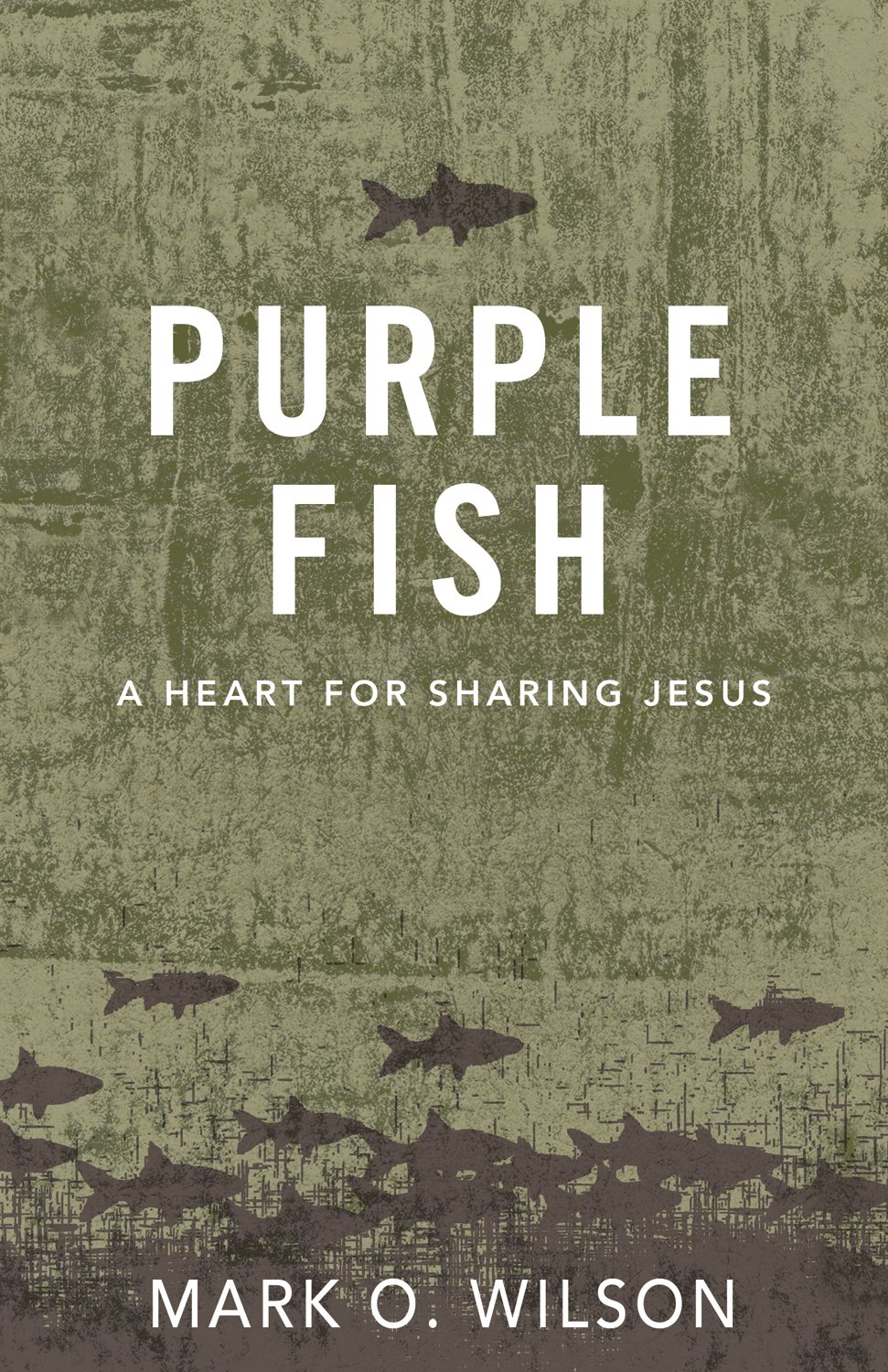
Purple Fish
By Mark O. Wilson

The topic is evangelism. Or is it fishing? In Mark O. Wilson’s book, Purple Fish, both activities become his topic. The book is peppered with stories of Jesus–and everyday people–“fishing for men.” You’ll also find stories about fishing for…well…fish.

The title comes from a Greek word, kalchaino, meaning “to search for the purple fish.” The purple fish referred to is highly treasured because of the deep purple dye found in this particular shellfish. Therefore, the treasured purple fish became the metaphor for Mark’s book.

fish-cover-2The purple fish secret, according to Wilson, is “more about attitude and perspective than technique.” And that’s why he doesn’t use “techniques.” Naturally, Wilson has advice for going forward with evangelism efforts. At the top of the list is prayer. If he has any kind of technique, it comes from his acrostic for finding connecting points with people.

Discussing Family, Interests, Situations, and Hurts with people, he says, helps us to find our common humanity and opens the door to telling the Good News of Christ. Wilson contends, like many, that evangelism is a process. He also spends time encouraging those with ichthyophobia (fears associated with sharing the gospel.)

Purple Fish is a book with simple ideas for evangelism, patterned after Christ’s model of meeting people where they are and approaching in love. Jesus didn’t follow the same method with each encounter and Wilson says this is the key to being the “second witness” in witnessing. The first witness of course, he says, is the Holy Spirit.

With thirty-three chapters, the book might seem daunting, but each is a quick read with no chapter longer than seven pages. If you’re the type that gets caught up in a book and says, “I just have to get through this next chapter,” this book is a cinch for you.

Because the book is written so simply and can be downright entertaining at times, Purple Fish will work well with small groups as well as an adjunct to a sermon series. Rather than being a text book-style reading on how to win people to Jesus, the book seriously and cheerfully mixes stories of fishing for fish and fishing for…well…people.

Mark Wilson is a seasoned pastor when it comes to evangelism, having taught nontraditional ministerial students through the Wesleyan FLAME program. He’s developed and put into practice methods that take people into the mission field of their own cities and neighborhoods. From the examples–he calls them ‘treasure hunts’–noted in this book, if his charges aren’t convinced before they begin of God’s power to draw people to Himself, they are convinced at the end of the day.

“Whatever”

A friend of mine once said that she didn’t believe her testimony would mean much to anyone. She didn’t think her story would have much impact. She said this because she’d been raised in the church and gave her life to Christ when she was quite young. She said there wasn’t any really “exciting” stuff to tell.

I’ve also heard numerous stories of people who’ve come to faith in Christ when they’re older, having lived a pretty wild lifestyle.

One might say that my friend was saved ‘from’ a pattern of sin and the second person was saved ‘out of’ a pattern of sin.

Whatever.

Please don’t think I take my brothers’ and sisters’ salvation lightly. By saying “whatever” I mean that, although God is pleased that we are now his children, no salvation story is better than another. I say that for two reasons.

The first reason is that both people–the one saved ‘from’ and the one saved ‘out of’–were saved by the same grace and power of the very same God. His love and the sacrifice of Jesus Christ is the basis for both salvation stories.

The other reason I say this is because both salvation stories can have impact and both glorify God.

I have friends who’ve seen family members come out of a wild lifestyle to become Christ followers and it convinced them of the truth of the Gospel. But I’m also familiar with a story of a man who wasn’t convinced even after hearing those testimonies. What convinced him was the power of God to enable a person to have no desire to ever enter into a wild lifestyle.

We all have a story to tell. Each one is unique and with value. We need to tell it.

When it comes right down to it, God says we have all sinned and fallen short of his glory. It really doesn’t matter what age we were or what we’d done or failed to do before we came to faith in Christ. We needed the grace he extended. So every testimony matters.

Are you sharing yours?

Live Christmas All Year Long

We’ve reached it: 2016 A.D.

Just a week ago, we were celebrating Jesus’ birth; today we look expectantly into a new year. At least as far as calendar years go.

With Christmas and the beginning of a new calendar year occurring a week apart, I pause to consider how the two might tie together.

What if we made a resolution to live the Christmas spirit all year long? Take a look at some ideas I thought of and see if you can come up with a few of your own. I’d be glad to hear of them.

Incorporate Music
Occasionally around the first of December, I’ll see my friends post on social media or say outright that they listen to Christmas music all year ‘round. They often sound like they’re apologizing. “I confess,” they say. I don’t think they need to apologize.

Think about it. Traditional Christmas carols are some of the best praise and worship music you can find. Most of them are ancient songs or at least from the last two centuries. o-come-emmanuel

I defy you to read–not sing–the lyrics of a Christmas carol and not see the true message of what Christmas means to Christians all over the world. Consider how listening to these hope-filled songs can turn a trial-filled time of life into a time of remembering God’s faithfulness.

Enjoy Fellowship
Throughout the year we naturally think of some specific days to enjoy fellowship with family or friends. Christmas, Thanksgiving, Easter, Mother’s Day, and Father’s Day for example. Why not go the extra mile (and avoid some of that grocery shopping craziness) and plan a get together in March? September? For no reason except to enjoy the fellowship.

Not to be maudlin, but we are never promised another glimpse of our loved ones once we’ve parted. I’ve heard too many stories of people who lost someone dear to them and one thing they regret is not getting together more often. Just celebrate life together. It doesn’t even have to revolve around food. But do it; you won’t be sorry.

This is one resolution I plan to carry out for sure with as much time as I’m given in the next year.

Enjoy the Wonder
The Christmas story I’m familiar with involves a single star guiding several men from the near east to a place in the Judean countryside. They found Jesus there. While I don’t claim to know how the tradition of lighting up our homes came into being, it has a place in my history.

As a child, my father would drive us around town to look at the brilliant light displays other people had come up with. We kids ooh-ed and aah-ed the same way we did during the 4th of July fireworks display.

Have you ever gone out to take a look at the starry sky on a clear night? It’s worth it to drive out to the country (avoiding light pollution) and watch the “silent stars go by.” That’s truly a credible use of the word ‘awesome.’dew covered web

Consider also that God has given us wonders closer than the starry sky. We often forget to notice the everyday happenings that, if we think deeper about them, are miracles. His creation gives us reason to stop and wonder. Colorful birds. Fragile, intricate spider webs. Clouds building into a thunderstorm. You get the picture.

The birth of a baby–even if it’s not Jesus–is always considered a ‘blessed event.’

Be Generous
One of my favorite Christmas stories is “A Christmas Carol.” Even though I know the story inside out, I’ve always enjoyed the end. Scrooge discovers what it really means to give to others; the act makes him feel incredibly alive.
Love, generosity and need know no season. We all can find ways to share more of our treasures: time, money, resources and affection. I’m encouraged by the words of Paul the apostle:

“He who did not spare his own Son, but gave him up for us all–how will he not also, along with him, graciously give us all things?” (Romans 8:32)

In addition to noting that God is generous, Paul says He is gracious.

Keep Hope Alive
If we can say one thing about Jesus coming to earth and the purpose of His life, ministry, death and resurrection, it’s this: We have hope for the future.

During any given year we may face trouble which seems to be more than we can stand. You may be thinking of the past year or one in recent history in which you experienced a heavy burden. We all can; it’s one of those things common to us all.

However, for those who receive Christ, the message of hope stands stronger than any trial. Jesus told his disciples that in this world there would definitely be trouble. He also assured them they could “Take heart” because He’d overcome the world.

Remember that hope is something we keep in our hearts to keep us going. It’s also a message we share because we want everyone to know what we know. God has a plan and that plan is for us to be His.

Anno Domini
A.D. stands for anno Domini. It means in the year of the Lord but is often translated as in the year of our Lord. It is occasionally set out more fully as anno Domini nostri Iesu (or Jesu) Christi (“in the year of Our Lord Jesus Christ”). The term anno Domini or A.D. is used to label or number years in the Julian and Gregorian calendars.

This calendar era is based on the traditionally reckoned year of the Jesus’ conception or birth. The dating system was devised in 525, but was not widely used until after 800. The Gregorian calendar is the most widely used calendar in the world today.

Is it any wonder?

He who gave so generously, with an accompaniment of angels’ music and the wonder of a bright star, brought the idea of fellowship in the Church and the reality of hope to us all.

Simeon and the Savior

Word made flesh visual

“When the time came for the purification rites required by the Law of Moses, Joseph and Mary took him to Jerusalem to present him to the Lord (as it is written in the Law of the Lord, “Every firstborn male is to be consecrated to the Lord”), and to offer a sacrifice in keeping with what is said in the Law of the Lord: “a pair of doves or two young pigeons.” Now there was a man in Jerusalem called Simeon, who was righteous and devout. He was waiting for the consolation of Israel, and the Holy Spirit was on him. It had been revealed to him by the Holy Spirit that he would not die before he had seen the Lord’s Messiah. Moved by the Spirit, he went into the temple courts. When the parents brought in the child Jesus to do for him what the custom of the Law required, Simeon took him in his arms and praised God” (Luke 2:22-28).

I read this and I want to be like Simeon. Surely righteous and devout, but also to speak to God with the confidence Simeon had when he praised God regarding the baby Jesus. That baby was exactly what the old gentleman had been waiting for.

He said, “Sovereign Lord, as you have promised, you now dismiss your servant in peace. For my eyes have seen your salvation” (Luke 2:29,30).

When it’s time for me to pass from this earth, I hope these are the words that occupy my mind and heart. I have been blessed to see God’s salvation.

During this advent season, the coming of Christ reminds me there is a wonderful hope for us. We have the promise of God’s glory when we know Jesus personally and trust Him as our Lord and savior. Like Simeon, we yearn to see Christ. We look forward to His return.

One of the secrets to Simeon’s story is this: he listened to the prompting of the Holy Spirit and went to the temple on that particular day. He knew from prior experience that the Spirit would speak and there was a promise in line with his going. He knew he would not die before laying eyes on the Messiah.

As I said, I’m blessed to know Jesus and His salvation.

And like Simeon, I look forward to laying eyes on Him.

Sometimes It Doesn’t Make Sense

Now a man came up to Jesus and asked, “Teacher, what good thing must I do to get eternal life?” Jesus answered, “If you want to be perfect, go, sell your possessions and give to the poor, and you will have treasure in heaven. Then come, follow me.” When the young man heard this, he went away sad, because he had great wealth. Matthew 19:16, 21, 22

What happens when there’s something we know for certain we need to do, but the action itself goes against what makes sense to us?

Do we ignore that nagging voice telling us to follow through?

God often gives instructions to act on what He says without explaining why. Perhaps you can relate to some of the stories in the Bible.

Joshua was a general. He followed Moses as leader of the Israelites when God led them to the Promised Land. It was now time for them to seize the property and take possession of it. The first city to be taken was Jericho.

God explained to Joshua that He had delivered Jericho into his hands. It implied that all the people had to do was follow God’s instructions. Imagine what some of the people must have thought when they were told the plan.

March around the city with all the armed men and the priests carrying the Ark of the Covenant for six days. On the seventh day, as they marched, the priests were to blow the trumpets. When they heard the long blast from the trumpets, God told Joshua to have the people shout loudly. “The walls of the city will collapse and the people will go up, every man straight in.”

Yell at a huge fortified city after marching in silence for six days? That doesn’t make sense. But they did it. The city fell.

God chose Gideon as a judge of Israel to defeat the Midianites who were constantly harassing the people. Here’s another example of God commanding a plan that doesn’t make sense to mere mortals.

To prepare for the battle, God told Gideon to reduce his troops to 300 men. First, the ones who were afraid to fight went home excused. The rest of the army was tested to see if they lapped water like dogs or with their hands to their mouths. Only the men who drank water in a ready position were retained.

Fight the enemy with only 300 men?

Gideon had previously been wary of God’s message that he was a “mighty man of valor” and even went so far as to ask for signs from God that He meant what He said. When Gideon asked, God didn’t become angry; He answered Gideon in the way Gideon requested. (Judges 6:36-40; 7:1-8)

Naaman, commander of King Aram’s army “was a valiant soldier, but he had leprosy.” He sought a way to be healed and one of his servants offered a solution. She suggested her master see the prophet Elisha. When Naaman arrived, Elisha sent a messenger to say that the commander should wash himself seven times in the Jordan River and his flesh would be restored.

Naaman went away angry. He had the idea that Elisha would intervene, calling on the name of the Lord for a miracle. When considering the solution given, he ranted that the Jordan was an unfit river and there were better ones in which he could dip himself.

Again, his servants seemed to grasp the situation better than he. They reasoned that if the prophet had told him to go and “do some great thing,” would he not have done it?

Washing in what Naaman thought was a dirty river didn’t make sense to him. But he went. He was cleansed. (2 Kings 5: 1-14)

The prophet Jeremiah had an inside track with God, continually receiving God’s word as a way to speak to the Israelites about His plans. The message that the people would be sent into exile wasn’t a pretty one. The message had been given by other prophets as well. Israel had plenty of warning about what was coming.

At one point, God told Jeremiah to buy a piece of land from his cousin. Surely buying property during a time of siege by the Babylonians must have seemed foolish to Jeremiah’s friends. Even to his enemies.

However, Jeremiah obeyed God when his cousin came to him in the courtyard of the guards. Despite the fact that he was a prisoner and the people would be exiled for seventy years, Jeremiah knew when God restored His people, “Houses, fields and vineyards (would) again be bought in (the) land.” (Jeremiah 32: 6-25)

Jesus’ chosen apostle, Peter, was a commercial fisherman. One day, after Jesus taught the people who gathered on the shore to hear Him, He told Peter to put his boat into deep water and let down the nets for a catch.

“Simon (Peter) answered, ‘Master, we’ve worked hard all night and haven’t caught anything. But because you say so, I will let down the nets.’”

After fishing all night and not catching a thing? Why now? That doesn’t make sense.

But Peter obeyed. And they caught such a large number of fish the nets broke. (Luke 5: 4-11)take first step

Who are you most like? Naaman, who argues God’s instructions? Gideon who doubts he can be used by God and asks for signs to be sure? Jeremiah who has an inside track and trusts God will come through? Or Joshua and Peter, who obey immediately because God “says so”?

Maybe you’ve acted like any one of them at some time. That would be understandable because faith can be a tricky thing.

Sometimes, as in Naaman’s case, we need other people to help us see what God is trying to do in our lives. Or we need to ask God for further clarification like Gideon did with the fleece. Then we can move with a small “army” instead of surging ahead full force.

As we mature spiritually, God gives us an “inside track.” We may still pray for a clearer vision, or depend on others to help us see how God intends His instructions for our benefit. Ultimately, we’ll come to a point in which we simply obey because God says so.

Even when it doesn’t make sense.

Imagine what would have happened for the young man whom Jesus told to sell his possessions and give to the poor. Imagine the rewards he would have seen and the joy that could have been his if he’d decided to obey, despite the fact that losing his riches didn’t make sense.

What is God asking you to do today that doesn’t seem to make sense? God’s thoughts are greater than ours. His ultimate plan may be hidden even though He provides a way to see His revealed will. Maybe today is the day to trust God and put our lives completely in His hands.

“We live by faith, not by sight” (2 Corinthians 5:7)

Ten Things I Believe

In 1990, just for fun, I came up with a list of “Things I Like.” Not surprisingly, ‘a nice cup of tea’ and ‘telling a joke well’ made the list.

Before the year was over, I’d considered that list and decided I needed to write another list of “Things I Need” (relationally). What I learned about writing and reviewing that list over time was that I was the one mostly responsible for making sure my relational needs were met. If I looked at it any other way, I felt like a victim.

Now, somewhat belatedly, I’m convinced another list is in order. A more important list, and probably not complete, I name “Things I Believe.” After all, I’m a Believer.

For what’s it’s worth, here it is. And the only items on the list I could say are in order of importance are perhaps #1 and #2.

1. I believe everything God said about Himself in scripture.Jesus Is ---

2. I believe everything Jesus said about Himself and that I am, because of my belief, now crucified with Him, reconciled to God, filled with the Holy Spirit, and will spend eternity with Him when He returns.

3. I believe there is a purpose in my life and that this purpose is to please God, however He defines His pleasure.

4. I believe the various experiences of my life–trials and joys, no matter when they happened–God is even now using to further His kingdom.

5. I believe in the intrinsic value of every human being.

6. I believe in the power of prayer.

7. I believe God speaks to people in a variety of ways and His purpose for speaking is for His glory to be shown in the world.

8. I believe there is an enemy in the world named Satan and that it is possible to be deceived by him as well as it is possible to stand against him with the power of God’s word and prayer.

9. I believe that there is a cost in loving as God commanded, but as we risk according to God’s definition of love, our relationships with Him become deeper. We are healed and our relationships with others become healthier.

10. I believe that my beliefs can and will affect my behavior.

Bonus belief: I believe that Numbers 1 and 2 are the basic foundation for the rest of the beliefs listed.

Back Up? Look Up!

“Let us fix our eyes on Jesus, the author and perfecter of our faith.” Hebrews 12:2

October has arrived and people are planning fall events, one of which is called a Corn Maze. They’re meant to provide family fun and sometimes a little bit of Halloween mischief.

A corn maze is like any other maze built of shrubs. The difference between a corn maze and a maze of shrubs from those puzzles in the magazines is they’re 3D. The idea with any maze puzzle is to find your way from the opening of the maze and, without hitting any barriers, make it to the other side, where you can exit.

The puzzles are designed to have natural stops and starts built into them.fall-corn-maze-2-kids

I’ve done these puzzles numerous times. For the puzzle to be challenging going over the barriers doesn’t make sense. Besides, that’s cheating.

I could draw a line through one, but what’s the point? It’s more fun and satisfying to solve the puzzle and getting through by following the natural openings offered at each turn.

Furthermore, once I’m in, I can’t go around the maze. That means I’ll need to back up sometimes and start over.

So really, the only way out is through.

Life is like that. The way through isn’t straight. There are always many possible directions that look like the way to go, but we meet barriers at every turn. Natural stops and starts. We have to look for the openings that lead to other openings.

In a historical novel I read a few years back, two children asked the heroine to run through a maze. The first time she tried, she got lost, not to mention frustrated, as they ran ahead of her. The children, however, encouraged her to try a second time.

“Look up, instead of down,” they told her. “It might be easier.”

The advice didn’t make sense to her, but partway in, she looked up. There, in the upstairs window stood her Beloved, looking down at her in the maze. From his vantage point, he could see every turn that would take her to the other side of the puzzle.

Because she trusted him, she kept looking up and he guided her all the way out.

Naturally, the only way out was through.

God Calling

Whenever I have questions about what it is God is trying to say to me (in any situation), this quote often comes to mind. Of course I rely on God’s word to remind me, but these words, like scripture, are also simple and clear.

In addition, they seem to come from someone who’s believed God and experienced His love. A love that is faithful and sweet no matter what the situation.


In all Your Journey as a Believer,
You will have two kinds of Spiritual Experiences.
One is tender, delightful, and loving.
The Other can be quite obscure,
dry, dark and desolate.
God gives us the First one to Gain us;
He gives us the Second to Purify us.

          ~ Michael Molinos, 17th Century Writer

Be a blessing to someone today

Questions For God

When I was a teenager, I began to have some doubts about my faith. Whenever I would say something even closely resembling such a thing, my mother would say, “Don’t question God, Paula.”

Now that my doubts have been cleared up, I have great faith in God and trust him with everything. However, that journey to complete trust wasn’t down an easy road. Most of the time I discovered his faithfulness through difficult times.

Something else I discovered through becoming familiar with scripture is that there is a difference between questioning God and asking him questions. Questioning him, in my opinion, displays an attitude based on a lack of trust. Asking questions is based on an honest search for God’s heart.

I look at people in the Bible as examples. King David asked questions in many of his psalms. The story of Job, a man God described as “blameless and upright” is full of questions he would like to ask God. The prophets, especially Jeremiah, had questions for God. Jeremiah wrote a whole “letter” to God full of lamentations. Mary asked Gabriel how God would accomplish the virgin birth.

Jesus wasn’t questioning his Father when he prayed in the Garden of Gethsemane to have the cup removed. He was lamenting what he would face in the crucifixion.

Often, it’s in this state of lament that we find ourselves asking hard questions of our Maker.Q A for blog

Examining these instances of lament–whoever it is in scripture–the people involved do the same thing. They often describe the situation to God. They ask their questions. Then they turn from the questions to praising God for what he’s done in the past. They tell him how much they trust him.

Looking back, I believe my doubts were simply a case of wanting some questions answered. I was an immature Christian and needed to have those answers.

Doubt isn’t inherently a bad thing. If our doubts lead us to ask questions and those questions lead us to sound belief, they can create a closer relationship with the Lord.

Doubt accompanied by the questioning attitude, however, can lead to a hard heart. That inevitably causes distance from God.

When we come to God with questions we may not always get an answer. Or the answer we hope for. But we’ll be drawing closer to him, remembering our dependence on him and remaining teachable by his Spirit.

Dear heavenly Father, help me to remember that there are people who, whether Christians or not, have sincere questions they need answered. Remind me that I still come to you with my own. Give me the ability to extend grace and not judge someone’s lack of faith because they have questions. I pray that all who seek you with all of our hearts–even through our questions–will find you as you have promised we will.

What Do We Have To Sing About?

Praise and worship in the form of hymns and contemporary music are a long-honored tradition in Christian churches. Whatever style of singing a church offers, the purpose is always the same: to glorify God.

We worship him for who he is and praise him for what he does.

Ever notice there are specific themes in the songs? Here are just a few.

Salvation The greatest gift of God is his Son, Jesus and the sacrifice of Christ on the cross. God gave his Son to die for us and we praise him for giving with immeasurable love. Without salvation, we cannot approach God. Through our faith in Jesus, we have him as our go-between.

Dependence We wouldn’t be able to accomplish anything of value or eternal purpose without God. We are weak and tend to wander, but with God’s power and our willingness to surrender to him, all things are possible.

Evangelism Christ has given us a mission to make disciples. With so many who haven’t heard the gospel, it’s a big responsibility. It’s an individual responsibility. “I love to tell the story of Jesus and his love” is a great attitude to have. Even better to put it into a loving action.

Suffering We all go through trials, but God provides strength to get through them even if he doesn’t remove them. We don’t praise God for the trials. However, lifting up his name as our source of strength is good for us. It helps us to remember his faithfulness.

Holiness In John’s revelation, he describes a scene in which creatures sing “Holy, holy, holy is the Lord God Almighty.” God is holy; we recognize this and worship as they did. Our own holiness is another topic of many songs. God said because he is holy, we must be as well. Again, we can do it only with his power working in us.

The Holy Spirit When we sing “open the eyes of my heart,” we’re asking the Holy Spirit to help us see spiritual truth. We humbly ask for his aid because we can block God’s word through various means. Even standing in church with the body of believers all around us, it can be difficult not to let our attention go elsewhere. The Holy Spirit desires our hearts be open to receiving God’s truth and bearing fruit.

Peace and Joy Two things Jesus said he gives to us which are not of this world. His peace. His joy. When we’re worshiping God for who he is, we can’t help feeling the peace and joy he gives. Acknowledging all of his attributes–from his holiness, justice and sovereignty to his mercy, love and forgiveness–we know we have a God and Savior who can bring peace and joy no matter what’s happening in our lives.

Love We sing about God’s love for us and we sing about our love for him. The former is praise, the latter is worship.

Gratitude Being always thankful to God is another excellent way to worship him. Gratitude doesn’t have to be sung, but when voices are lifted up to praise God with our mouth saying, “Hallelujah!” God hears and is exalted.

We have many things to sing about when it comes to our Father in heaven. Don’t have a great singing voice in your own opinion? Be assured that God doesn’t see it that way. He gave you that voice.

So lift it up in worship. Bless His holy name.